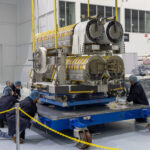
In February 2026, an anomaly onboard the Proba-3 mission’s Coronagraph spacecraft led to loss of contact between the spacecraft and ground control. Redwire’s PROBA-3 team, based in Kruibeke, Belgium, sprang into action, playing a leading role in the highly collaborative, international recovery effort. Redwire is pleased to report that the CSC satellite has been fully recovered without any permanent damage, preserving this important mission.
The Purpose of PROBA-3
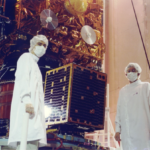
The PROBA-3 mission is led by ESA, and Redwire was responsible for spacecraft integration, testing, and providing the onboard computer through a contract with Sener, the mission’s prime contractor.
The PROBA-3 mission is composed of two spacecraft, Coronagraph (CSC) and Occulter (OSC), and was launched in December 2024 to study the Sun’s corona.
The mission launched from the Satish Dhawan Space Centre in India with a two-part purpose. First: studying the Sun’s corona, a dynamic region with the largest influence on Earth through events like solar flares or mass ejections. Second: the demonstration of formation flying technologies and rendezvous experiments that would benefit future science, astronomy, and Earth observation missions.
By June 2025, PROBA-3 had accomplished both mission objectives: the two spacecraft were fully commissioned and able to perform autonomous precision formation flying. This led to the creation of the first artificial solar eclipse in space, as well as the capturing of never-before-seen images of our favorite star’s corona.

Despite these early successes, formation flying requires immense precision, as the two spacecraft must maintain their position with an accuracy of 1 millimeter across a distance of 150 meters.
Lose one spacecraft, and the PROBA-3 mission would be finished.
A Mission at Risk: Data from Coronagraph Interrupted
On February 14, 2026, when an anomaly onboard Coronagraph led to the loss of spacecraft orientation and prevented its entry into safe mode. The satellite’s solar panel was no longer facing the sun, draining its battery and causing Coronagraph to drift away from its partner Occulter.
To avoid losing the spacecraft entirely, ESA, Redwire, and industry partners had to act quickly.
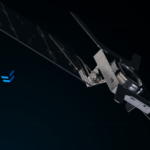
Redwire’s team immediately joined the international effort to discover the root cause of the anomaly, as well as what might be done to recover Coronagraph. After at least four different theories were tested but failed to restore communication, the team finally located the lost satellite by imagery and were able to make optical measurements from the ground. By measuring the satellite’s rotation rate, it was determined the spacecraft was thankfully not in a “death roll”, allowing the team to predict when Coronagraph would next be pointing toward the Sun. This positioning would enable ground control to turn the solar panel back on and hopefully retake command of the satellite.

Signal Restored and Satellite Recovered
On March 18, the ground station at Villafranca, Spain, called ESA to report they had received data from Coronagraph.
But because the spacecraft had spent a month in the extreme cold of space, its onboard systems and a half-frozen fuel tank required time to warm up. Fortunately, with the Coronagraph’s solar panel now facing the Sun, all essential electronics began receiving power.
A few days later, the inter-satellite link (ISL) was switched on, restoring communication between Coronagraph and Occulter for the first time since February 14. Once the fuel tank had warmed, propulsion was also restored.
By April 1, the spacecraft showed enough signs of good health for the ground team to make the transition from safe mode to manual mode, gaining more control over the satellite. Both CSC and OSC then received new software, which not only enabled continuation of the mission, but allowed the spacecraft to perform formation flying with even greater precision.
Following a few more maintenance updates, normal mission operations for PROBA-3 were fully restored and resumed formation flying is planned for early June.
Congratulations to ESA, our partners, and Redwire’s Proba-3 team whose tireless problem-solving and teamwork made this unprecedented recovery a reality.
Read more about Redwire’s contribution to Proba-3 here: Proba-3 | Redwire