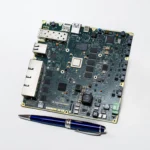
Redwire launched additional colloids experiments to the International Space Station (ISS) onboard a recent commercial resupply mission to the ISS. These modules support Redwire’s Colloidal Solids Instrument (COLIS), a powerful research platform advancing our understanding of diseases, drug development, advanced materials, industrial processes, and biomedical applications.
Why Study Colloids in Space?
When sunscreen thickens over time or mayonnaise slowly separates in your fridge, it’s not just bad luck. It’s because the tiny particles inside these materials rearrange themselves in ways scientists still don’t fully understand. Unlocking how materials form, evolve, and sometimes fail at the microscopic level is essential for breakthroughs across pharmaceuticals, materials science, and manufacturing.
But there’s a challenge: On Earth, gravity constantly pulls particles downward, causing them to settle, clump, or separate. This makes it difficult to observe how materials naturally organize and behave.
That’s why scientists take this research to microgravity.
About COLIS
Developed by Redwire for the European Space Agency (ESA), COLIS is a state-of-the-art optical laboratory designed to study colloids, materials made of tiny particles suspended in a fluid, without the interference of gravity. COLIS has been operating on the ISS since August 2024, and Redwire continues to design and manufacture new cell modules that regularly fly to station to support a wide range of investigations.

Previous COLIS Investigations
Redwire has launched several types of cell modules for COLIS, including:
- Colloidal glass sample (August 4, 2024): Colloidal glass mimics the behavior of molecular glass in a simpler form. This investigation improved understanding of how glasses form and behave, informing the development of new materials and shedding light on natural processes.
- Protein solution (August 24, 2025): Studying protein crystallization in microgravity helps scientists observe crystal formation without gravitational interference. These insights can support improved drug formulations and delivery systems.
- Gel sample (August 24, 2025): Research into gel behavior in microgravity may lead to better formulations for gels and emulsions used in food, cosmetics, and other consumer products.
New Cell Modules Launch to the ISS
On April 11, 2026, two new COLIS cell modules launched to the ISS onboard NASA’s Northrup Grumman Commercial Resupply Services 24 mission. Both contain new protein samples that will be used to study how proteins crystallize in microgravity. This research could inform future drug development and biomedical innovation.
The insights generated by COLIS could extend far beyond fundamental science. By revealing how soft materials self-organize and evolve, this research might help pave the way for safer, stronger, and more sustainable materials used in everyday life on Earth.
Read more about previous COLIS spaceflight investigations here: Redwire Instrument Launching to the ISS to Give Insight into the Functioning of Various Diseases | Redwire