Redwire Space has the Technology, Talent, and Partners to Lead the New Space Era
Going to space —especially deep space — is hard. Just ask the Apollo 11 astronauts, Neil Armstrong and Buzz Aldrin, who voyaged to the lunar surface 60 years ago taking “one small step for a man, one giant leap for mankind.” Despite that momentous landing in the summer of ’69, only a handful of subsequent missions were able to reach the lunar surface, and humans have not returned in over 50 years.
However, affordable launch and advances in commercial space, autonomous systems, artificial intelligence (AI), and the realization of space’s vast promise have ignited a new era of space exploration, one that will benefit greatly from public/private partnerships, international collaborations, and tech ingenuity, whether the destination is the Moon, Mars, or beyond. Rewire stands ready to enable that future.
“For anyone operating in space, Redwire’s diverse and flight-proven offerings can make your mission more successful, affordable, and capable,” says Mike Gold, Redwire’s president of Civil and International Space.
The company brings an impressive flight heritage for missions ranging from planetary defense to cutting-edge in-space manufacturing and biomedical research. But perhaps its secret weapon is much closer to home—its people.
“Redwire personnel, much like our products, come with extraordinary experience, but also with an entrepreneurial vision and attitude that allows us to innovate at a high level, while delivering unparalleled quality and value,” says Gold, observing that Redwire people “are an excellent combination of dreamers and visionaries grounded in practicality.”
As a team Redwire always looks forward, realizing that “the work we do today, even the small actions, is creating an exciting tomorrow. Our team isn’t just building better technology, we’re building a better future,” he adds.
Perhaps no one fits that desire to build a better future better than Gold himself. Before joining Redwire, he served as NASA associate administrator of space policy and partnerships, where he led the development and implementation of both the Artemis Accords, a shared set of principles for exploring space, now signed by 55 nations as of May 2025, and the binding agreements with international partners that established the lunar Gateway (a space station which will orbit the Moon and substantially enhance lunar surface operations).
Enabling Technologies
A world-leading innovator in power, Redwire is producing the largest solar array ever to fly in space. Redwire’s Roll-Out Solar Arrays, or ROSAs, are a key part of the Gateway’s Power and Propulsion Element. The Gateway ROSA’s represent the culmination of this innovative solar array technology leveraging years of heritage on the International Space Station, the Double Asteroid Redirect Test mission, and other programs.
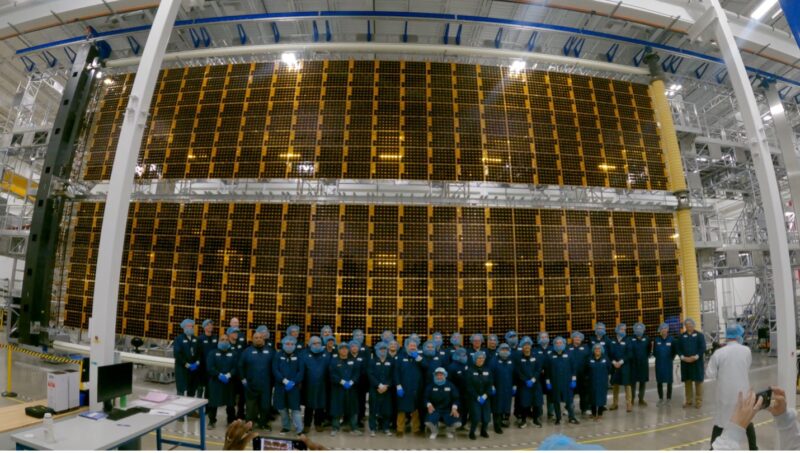
According to Gold, ROSA doesn’t just roll out; it can also retract, a feature that will prove beneficial on the Moon, since the surface is covered in regolith, or moon dust, that has proven nightmarish for space operations.
“Redwire has several approaches for regolith removal that complements the ROSA design. This feature is extremely important for being able to maintain power and operations on the surface. As we look at Mars, those capabilities are going to be equally valuable,” he adds.
A fundamental challenge for lunar and Martian missions, both orbital and surface, is the lack of persistent communications and Position, Navigation, and Timing (PNT) infrastructure. Unlike Earth, numerous ground stations and constellations of spacecraft providing communications and GPS are not available.
“Future missions to the Moon and Mars will need a level of autonomy,” says Dana Turse, Redwire senior space systems architect. “Autonomous guidance, navigation and control (GN&C) and maneuvering in the absence of persistent connectivity with Earth-based systems and operators will open up the possibility for more ambitious missions to the Moon and Mars.”
Redwire is developing multiple approaches for communications and position navigation and timing (PNT) to address these issues. “We are partnering on initiatives for novel forms of GNC and PNT that are AI and Machine Learning-enabled,” says Turse.
Redwire also participated on DARPA’s LunA-10 study, which was focused on developing an architecture for the lunar infrastructure that could enable a commercial lunar ecosystem.
“We were excited to be part of this study – we are believers in the goal of LunA-10, and made headway toward understanding the needs for power, communications, PNT and other services at the Moon to foster a strong commercial lunar ecosystem,” says Turse.
Redwire engaged in a NASA study to investigate commercial service missions to Mars to establish payload delivery, communications, and surface imagery infrastructure. Redwire specifically led the study on a high-performance imaging mission that would perform surface imaging of Mars using modified commercial components.
“This study helped NASA define its future of engaging with commercial industry for necessary planetary infrastructure,” says Kari Abromitis, Redwire’s senior lead for space infrastructure, who led the effort last year.
Other areas of active development for Redwire include low-impact berthing and docking systems as well as electric propulsion and active thermal management systems. All these systems will be critical for safer, more capable and longer duration missions to the Moon and Mars.
Building Docking Ports for Future Space Habitats
When the Lunar Gateway habitat becomes operational in the coming years, it will feature a resilient, high-performance and low-impact berthing and docking solution designed by Redwire. The company’s Belgium team is leading design and testing of the system for the European Space Agency, which is overseeing both the International Habitat and the Esprit Refueling Module on the Lunar Gateway.
Known as the International Berthing and Docking Mechanism (IBDM) system, the system features autonomous docking of crewed vehicles and station modules, the safe capture and damping, also in case of vehicle power failure, the berthing and reberthing of vehicles. The solution is fully computer-controlled and designed for use with both large mass and very lightweight spacecraft.
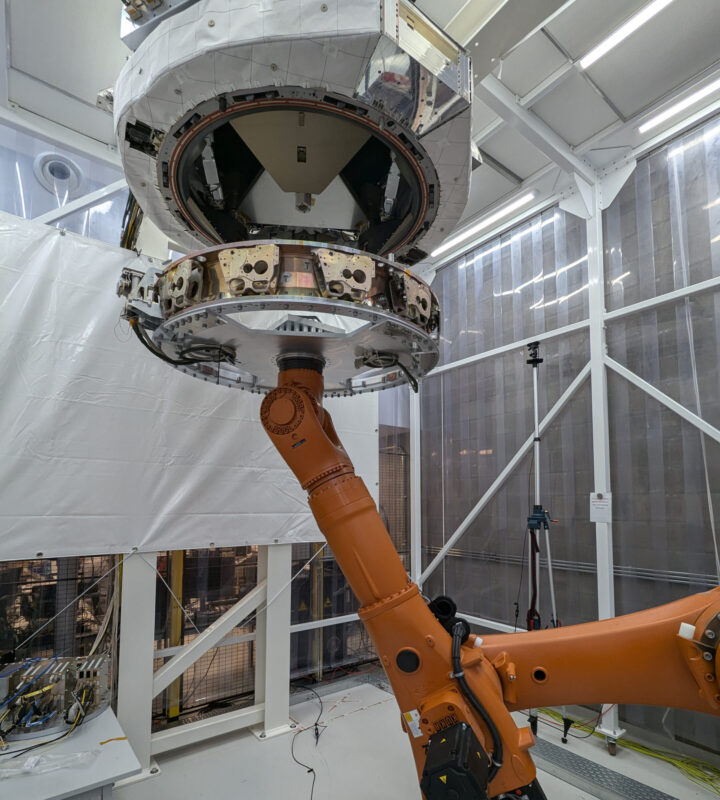
As the European Space Agency’s prime contractor for IBDM, Redwire recently began building one active and three passive units. The active IBDM system will connect the Lunar I-Hab module to the Gateway Space Station. Lunar I-Hab will offer living quarters, laboratory space, and mission support for astronauts on long-duration deep space missions, while the Gateway Space Station will serve as a lunar-orbiting outpost.
“The International Berthing and Docking Mechanism is a critical enabler of truly international space exploration. It offers a high-performance, low-impact solution for securely and autonomously connecting spacecraft, modules, and stations in orbit and beyond. Its versatility and compliance with international docking standards will make it a key system for cooperative operations on the Lunar Gateway and future deep space missions,” says Luc Van den Torren, IBDM Portfolio Lead.
Leading with Partners
Redwire’s Moon and Mars vision benefits from strong global partnerships across industry, academia, and government.
“Public-Private Partnerships created this new golden age of space. We need to continue to leverage this wildly successful paradigm to make even more robust progress in the future,” says Gold.
NASA has been a trailblazer with public-private partnerships through programs such as Commercial Orbital Transportation Services, Commercial Resupply Services, and Commercial Lunar Payload Services (CLPS).
When it comes to partnering globally, Redwire itself is global, with numerous offices in the U.S. as well as Belgium, Luxembourg, Poland, Canada, and Latvia in Europe.
“In these uncertain times, Redwire technology and systems can provide nations with independent, autonomous capabilities that are both reliable and affordable,” Gold says.
Redwire and its partners are leading efforts to forge a sustainable presence in deep space, utilizing the company’s proven modeling, simulation, and digital engineering capabilities. For example, Redwire’s Digital Ecosystem for Mission and System Integration (DEMSI) solution will be used to model applications for Redwire’s Mason tool suite set to deploy to the lunar surface.

Redwire engineers and program teams also use digital twins, or virtual replicas of systems, to simulate the environment of the Moon. Creating high-fidelity replicas are necessary to analyze the impact of dust or radiation on equipment, as well as to verify and validate robotic operations in orbit and on the surface.
Mason: Turning Regolith into Building Blocks for the Lunar (and Martian) Surface
Once on the surface of the Moon or Mars, humans will struggle with building infrastructure in a harsh environment surrounded by dust, soil, and broken rocks known as regolith.
“When you’re on the Moon, an adversary potentially more problematic than even China is regolith,” says Gold.
This loose, abrasive ‘dirt’ on the lunar surface can become a dangerous projectile when accelerated by a rocket’s exhaust plume. Repeated landings disrupting the prolific dust also can affect nearby habitats.
Mason, Redwire’s first-of-its-kind manufacturing technology, can help turn regolith into a type of ‘cement’ that can serve as a building block for structures. Designed to be platform agnostic for use on different landers, rovers, or robotic arms, the Mason suite of tools can withstand the dramatic swings in temperature while operating autonomously. The tool suite initially includes BASE (a grader), PACT (a compactor) and M3LT (a microwave emitter).
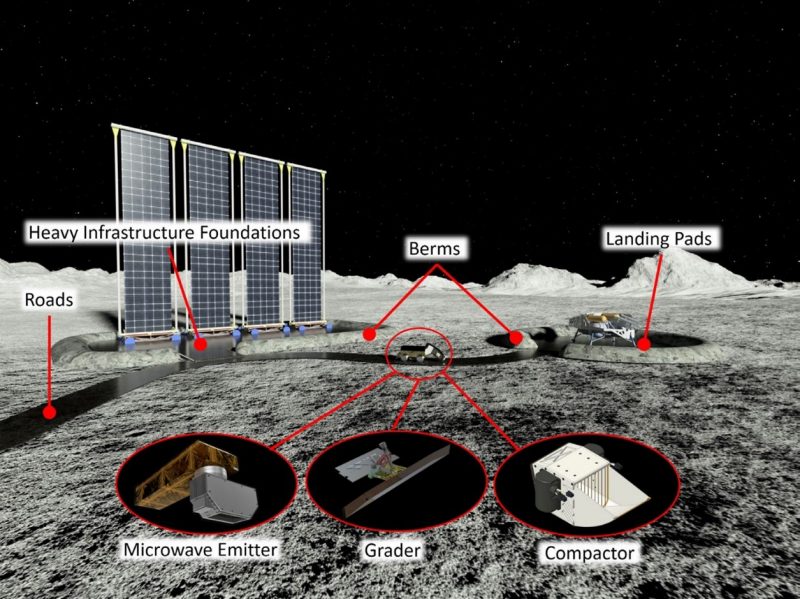
Collectively, they compact and push away rocks and other level surfaces, turning regolith into solid, dense material after it’s heated to high temperatures. This solid concrete-like material can then serve as a building block for berms, landing pads, roads, foundations, and future habitats. Redwire believes Mason offers a path to allow robust construction on the lunar surface using both human and robotic operations. Both are needed for a long-term human presence on the Moon and the creation of a dynamic lunar economy.
“Our goal is to create infrastructure that facilitates the safe landing and launching of rockets from the moon’s surface, while preventing damage to lunar hardware and satellites caused by high-velocity regolith ejecta,” says Dr. Patrick Flowers, Redwire Materials and Mechanical Engineering Manager and Principal Investigator of Mason, which is managed under a Tipping Point agreement with NASA’s Space Technology Mission Directorate.
Redwire’s Mason partners include NASA Kennedy Space Center Swamp Works, Lambda Technologies, Colorado School of Mines, and the University of Central Florida, all committed to the vision of supporting a long-term presence on and exploration of the lunar surface.
In June, Redwire announced it had completed Mason’s Critical Design Review with NASA, a milestone that brings Mason one step closer to launch. Now, the team has begun fabricating a critical design prototype and conducting functional testing of the three tools, as it explores flight opportunities for a demonstration mission.
The Right Stuff
Fundamentally, the push to the Moon and Mars signifies something deeper than exploration— it’s about permanent off-planet settlements.
“Talking about what is really needed to establish commercial economies on the Moon and Mars is an exciting topic for me,” says Turse, adding that Redwire’s mantra is to develop critical infrastructure to support a lunar and eventually, Martian economy.
She expressed enthusiasm that Redwire and the commercial space industry overall can tackle the challenges that deep space exploration poses.
“These are really big challenges, and the industry has all the right stuff to solve them. Redwire, with all our capabilities, is very well positioned to address many of these technical challenges,” Turse concludes.
Read more about Redwire’s role in our journey to the Moon, Mars, and beyond: Redwire Receives NASA Approval to Advance Cutting-Edge Manufacturing Technology for Building Infrastructure on Moon and Mars | Redwire Space