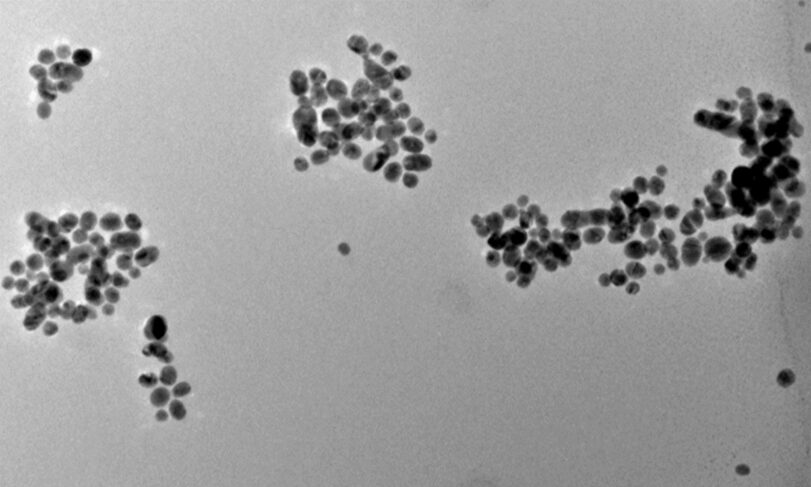
Redwire’s Chief Scientist, Dr. Kenneth Savin, on the gold nanospheres experiments that could revolutionize early detection and treatment of diseases on the ground
In the future, people may know from a tiny blood sample whether they have cancer or another disease, thanks to advances in crystallization research in space giving new life to nanomedicine.
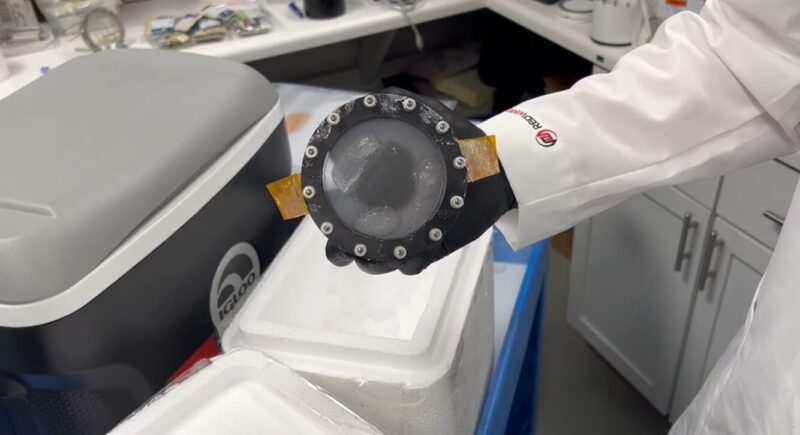
In April, Redwire helped move humanity a step closer to that reality, launching to the International Space Station (ISS) a revolutionary new test facility, the Industrial Crystallizer, and a series of experiments with precursor materials in the hopes of making gold nanospheres (GNS), versatile and tiny gold particles that can be used as part of a system to effectively identify particular cells. This first-of its kind investigation, called Project Golden Balls, will attempt to produce GNS in space for the first time ever.
Significantly smaller than an average cell, and similar in size to proteins, nanoparticles are ideal for interacting with biomolecules and transporting drug molecules across cell membranes. The challenge has been controlling their nanoparticle size and shape.
Microgravity’s Role in Ensuring Uniform Spheres
Microgravity offers the perfect environment to create nanospheres with uniform size and shape needed to deliver precision medicine. Such precision isn’t possible on Earth because of the force of gravity, explains Dr. Kenneth Savin, Chief Scientist at Redwire.
Nanoscale tools and techniques are not a new area of exploration for targeted drug delivery systems, but the material used, gold, and conditions under which Redwire is testing it, are unique and potentially revolutionary.
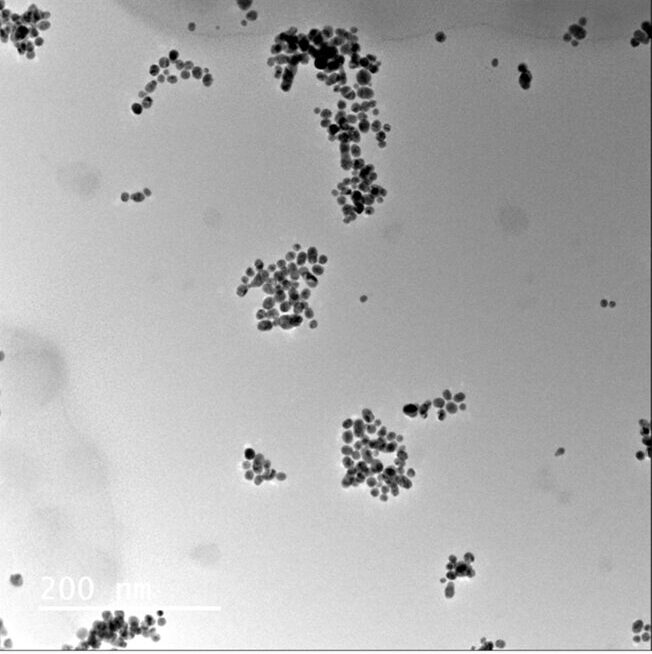
Because of its density, gold is more susceptible to the influence of gravity. In the absence of gravity and exposed to the more quiescent environment of low-Earth orbit, Redwire should be able to generate smoother, more consistently sized and shaped nanospheres.
Fast, Accurate Blood Tests to Detect Cancer
“If our experiments succeed, it could lead to early testing and diagnoses of cancer and other diseases,” Savin says. “Devices that allow you to do very fast, accurate testing are of real value. Just 10 grams of gold nanospheres, or a third of an ounce, would be enough for around 10,000 blood tests.”
Savin says the next step would involve not only working on an in-space facility but also developing a logistical process for producing GNS “on a routine basis” and fitting it into a commercial supply chain.
“We are the best in the world at putting together technologies that enable science in space and allow people to do unique and focused science and do it in a very deliberate and accurate way,” Savin says.
The soft-spoken chemist joined Redwire in 2022 after a two-decade career at Eli Lilly and Company, where he led a team of scientists to develop and fly five experiments on the ISS. He also did a stint leading scientific partnerships for the ISS U.S. National Lab.
For the past year, Savin has guided undergraduate students at Redwire’s academic partner, Butler University, to get the GNS experiments flight ready. He credits the students with helping ensure the hardware would function in microgravity. A dedicated Butler researcher quickly determined the best temperature and concentration conditions for the formation of the gold nanospheres.
“This is our first flight of the GNS project, and we are really excited to see the results,” said Anne Wilson, a professor in the Chemistry Department at Butler University. “At Butler, we are able to perform reactions safely in preparation for testing the flight hardware. We also test the system in the flight hardware with the appropriate precautions in place.”
Redwire is seeking partnerships, both with companies building commercial space stations through NASA’s Commercial Space Stations program, and medical device companies who could turn the GNS into a product line for blood analyses. Savin recalls that during his two decades at Lilly, people were living longer with cancer.
“What was really happening was we were getting better at diagnosing cancer earlier,” he observes. He contends that advances like nanospheres could lead to even earlier diagnoses. “If you sense it early enough, you may be able to fix the problem before it gets way out of hand.”
The end goal is clear: delivering a superior test device that provides value to patients and changes lives.
Looking Ahead
Savin, for his part, is excited for the future. “I’ve retired twice, but I love it,” he says. “I’m having a great time, working with great people, doing fantastical, crazy things that I think will ultimately have an impact on people’s lives.”
He considers the work underway as humanity’s first steps to accomplish real things in space beyond exploration. “It’s like we’re learning a whole new field of science all over again,” he says.
Learn more about the Industrial Crystallizer and Redwire’s expanding in-space drug development program here.